


AI in Manufacturing Automation Guide

Conveyor systems have quietly evolved from simple mechanical transport into data-driven infrastructure. The rise of AI in manufacturing automation is turning conveyors from passive belts into active decision-making components of a production line. Understanding how artificial intelligence and automation intersect — and where the real gains lie — helps manufacturers evaluate whether an upgrade is worth the investment.

Automation and AI Are Not the Same Thing
It's worth separating the two terms, since they're often used interchangeably. Automation refers to the physical systems — motors, sensors, actuators — that move, sort, or lift products without direct human input. AI in manufacturing automation is the decision-making layer sitting on top of that hardware, analysing data and adjusting behaviour in response to changing conditions. A conveyor can be automated without being intelligent; adding AI is what allows it to adapt rather than simply repeat a fixed cycle.
Predictive Maintenance Is the Clearest Return on Investment
The most measurable application of AI in manufacturing automation is predictive maintenance. IoT sensors continuously track motor temperature, vibration, and belt alignment, while machine learning models compare live readings against historical baselines to flag anomalies before they cause a breakdown. Industry data suggests this approach can cut unplanned downtime by up to 35–45%, and in some cases reduce conveyor-related downtime by as much as 70% compared with reactive maintenance schedules.
Facilities running high-end monitored conveyor systems report uptime levels above 98%, compared with three times more unplanned downtime for sites relying on low-cost, unmonitored equipment. Rather than servicing parts on a fixed calendar, predictive models allow maintenance teams to replace components only when wear indicators justify it, which reduces both labour hours and spare parts spend.
Machine Vision Adds a Layer of Quality Control
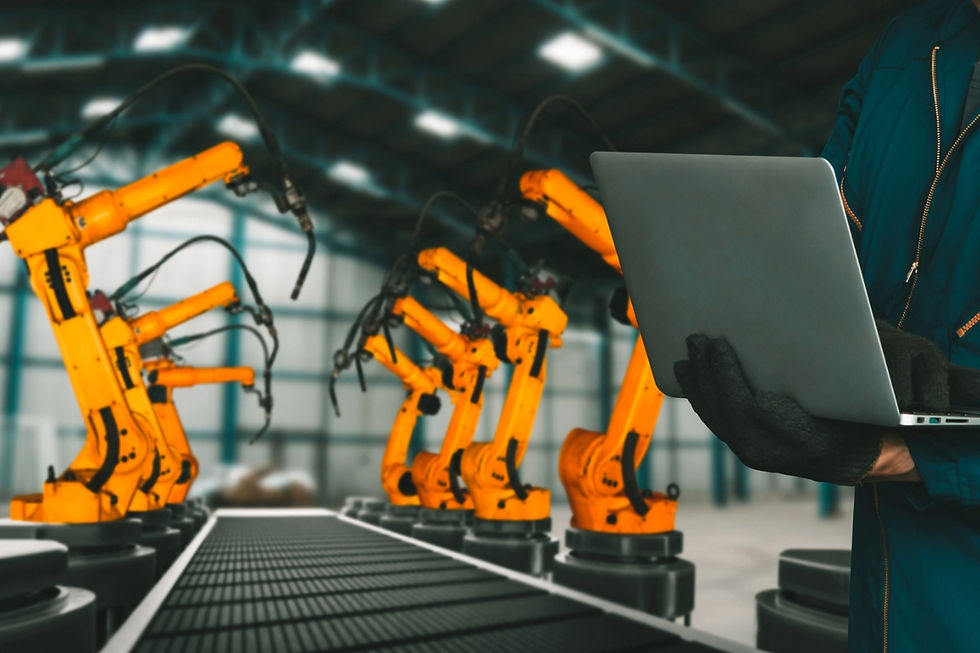
Beyond maintenance, AI-powered machine vision is increasingly used for in-line inspection. High-resolution cameras positioned along the conveyor capture continuous images of products as they pass, and machine learning models compare each frame against known defect profiles in real time. When an anomaly is detected — a misaligned label, a cracked component, an incorrect fill level — the system can flag it, log the event, and in more advanced setups trigger an automatic diversion or rejection, reducing the need for manual quality checks.
Adaptive Flow Control for Variable Production
Traditional conveyors run at a fixed speed regardless of what's on them. AI-enabled systems can adjust speed and routing dynamically based on product size, weight, order volume, or even real-time demand signals from upstream systems. This matters most in facilities handling mixed product lines or fluctuating order volumes, such as food and beverage or pharmaceutical packaging, where a rigid conveyor setup either bottlenecks or wastes capacity. Some systems are beginning to incorporate self-learning capability, where the conveyor adjusts its own parameters over time based on accumulated operational data rather than requiring manual recalibration.
Sustainability Gains From Smarter Operation
Energy consumption is a growing consideration in manufacturing automation decisions. AI-managed conveyors can scale motor output to actual load rather than running at a constant rate, and some systems pair this with battery-electric drive components to further cut energy use. While the sustainability case is less quantified than predictive maintenance, it's a consistent secondary benefit cited across current material handling automation trends.

Where AI Fits Into a Wider Automation Strategy
AI in manufacturing automation rarely operates in isolation. It typically works alongside autonomous mobile robots (AMRs), automated guided vehicles (AGVs), and warehouse or manufacturing execution systems that share data across the floor. A conveyor's sensor data can feed into broader inventory or production planning systems, and conversely, demand data from those systems can inform how the conveyor behaves — closing the loop between physical material flow and operational decision-making.
Practical Considerations Before Investing
AI-enabled conveyor upgrades are not a universal fit. The clearest business case exists where downtime is expensive, product variability is high, or quality control currently relies heavily on manual inspection. For simpler, high-volume, low-variability lines, the incremental cost of sensor arrays and machine learning infrastructure may not be justified by the marginal efficiency gain. Manufacturers considering an upgrade should look at current downtime costs, defect rates, and product mix variability as the starting point for a cost-benefit assessment, rather than treating AI integration as a default improvement.
AI in Manufacturing - The Direction of Travel
The trajectory of AI in manufacturing automation points toward conveyors that monitor themselves, flag their own maintenance needs, inspect their own output, and adjust their own operating parameters with minimal human input. That shift is incremental rather than instant — most facilities are adopting these capabilities piece by piece, starting with predictive maintenance and vision inspection before moving to fully adaptive flow control. For manufacturers evaluating conveyor upgrades, the practical question isn't whether to adopt AI, but which specific capability addresses their most costly operational problem first.


Comments