


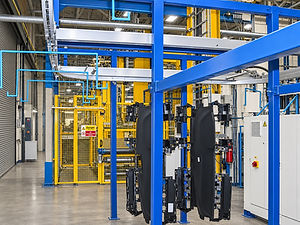


Overhead handling, designed around your process
From moving components between assembly stations to transporting garments, totes or parts through a finishing process, an overhead system can help reduce repetitive handling and keep floor space available for other activities.
How does an overhead conveyor work?
Products are suspended from carriers that travel along a track supported by the building structure or a freestanding steel framework. Depending on the application, carriers may use hooks, hangers, trays, slings or fixtures designed around a particular product.
Movement can be manual or powered. Simple systems follow a continuous route, while more advanced designs allow individual carriers to stop, queue or take different paths through the facility.
The right arrangement depends on the load, the process and the space available.
Choosing the right conveyor
Powered chain conveyors
A driven chain pulls carriers around a defined route. This arrangement suits repetitive operations where products need to move through a consistent sequence, such as assembly, painting or finishing.
Power and free conveyors
Power and free systems give greater control over individual loads. Carriers can disengage from the driven track, allowing products to wait in a buffer, stop at a workstation or divert onto another route while other sections continue moving.
This flexibility is useful where different processes run at different speeds or products require different treatment.
Electrified monorail systems
Electrified monorails use individually powered carriers, allowing loads to travel independently along the rail. Suitable controls can manage carrier speeds, destinations and stopping positions to support more complex transport requirements.
Manual overhead tracks
Manually operated tracks provide a straightforward way to move suspended loads between work areas. They can suit lower-volume operations, local transfer tasks and processes where powered movement is unnecessary.
Where overhead conveyors can help
Overhead transport is particularly useful when products need to pass through several stages without repeatedly being lifted, carried or transferred between handling equipment.
Typical applications include:
-
Production and assembly: Delivering components to workstations and moving products between assembly, testing and inspection.
-
Painting and surface treatment: Carrying parts through preparation, coating, drying and curing stages.
-
Warehouse transfers: Moving suitable loads between storage, picking, packing and processing areas.
-
Garment handling: Transporting hanging clothing through sorting, storage, dispatch and returns.
-
Process buffering: Holding work in progress until the next operation is ready.
-
Returns and rework: Directing items towards inspection, repair or another processing route.
Systems used in ovens, wash areas or other demanding environments need components and materials specified for those conditions.
Benefits for your operation
Recover useful floor space
Moving transport routes overhead can release space for machinery, workstations or storage. The layout still needs to account for supporting structures, access, loading points and maintenance.
Reduce repeated handling
A connected conveyor route can cut the number of times employees need to lift or carry products between processes, helping teams spend more time on production and other skilled tasks.
Keep work moving consistently
Controlled movement and correctly sized buffers can help coordinate production stages, manage queues and reduce interruptions caused by uneven material delivery.
Improve access to products
Purpose-designed carriers can present components at a suitable position for assembly, inspection or finishing. Secure, consistent presentation can also help limit unnecessary contact and handling damage.
Support product tracking
Identification and tracking equipment can link each carrier to its load, helping operators monitor progress and direct products to the next required stage.
Plan for changing requirements
A system designed with future needs in mind may allow additional routes, workstations or buffer areas as production develops. Expansion options depend on the original layout, structural capacity and control system.
Applications across industry
Automotive and component manufacturing
Movement of parts through assembly, paint and finishing operations, with delivery to the required workstation.
Warehousing and distribution
Transfer of suitable hanging items or carrier-mounted goods between handling areas, including returns and exception processing.
Fashion and retail
Hanging garment transport, sorting and delivery to packing or dispatch.
Aerospace
Controlled movement of components through treatment, coating, inspection and assembly stages.
Appliances and electronics
Transfers between assembly, testing and packing, with buffers where processing times vary.
Food and beverage facilities
Handling of suitable crates, containers and equipment, with hygiene, cleaning and environmental requirements considered during specification.
Connect transport with your wider operation
An overhead conveyor can work alongside existing equipment or form part of a broader automation project.
Loading and unloading points can connect with belt or roller conveyors, lifting equipment, robots and manual workstations. Routing controls can send products towards the correct process, while buffer areas hold loads until downstream equipment is ready.
Depending on the application, the system can also incorporate:
-
Barcode or RFID identification to associate products with carriers and record their movement.
-
Sensors to confirm load presence, carrier position and equipment status.
-
Camera inspection to support checks such as component presence, orientation or label reading.
-
Production and warehouse software connections to exchange routing instructions and progress updates.
-
Performance monitoring to help teams understand throughput, stoppages and maintenance needs.
These features should be selected around a clear operational need and the capabilities of the connected equipment.
Specify a system around your process
A successful overhead conveyor starts with understanding what needs to move and how the operation works.
Key considerations include product dimensions and weight, carrier spacing, required throughput, changes in elevation, stopping points and available headroom. Building capacity, maintenance access, cleaning requirements and the working environment also influence the design.
Safety needs to be considered throughout, including load retention, guarding, emergency stops and the movement of people and vehicles beneath or around the conveyor.
Together, these details establish a practical specification for the track, carriers, drive and controls.
Frequently asked questions
Can an overhead conveyor carry heavy products?
Suitable systems can handle substantial loads, but capacity depends on the track, carriers, drive and supporting structure. The complete load, including its carrier, must be considered when specifying the equipment.
Can products stop while the rest of the conveyor keeps moving?
Yes, with an appropriate system. Power and free conveyors and individually controlled monorails can allow loads to stop or accumulate while other carriers continue along their routes.
Can a conveyor fit into an existing facility?
Often, although feasibility depends on the building, available clearances and existing equipment. A layout assessment helps establish suitable routes, support positions and loading arrangements.
Can it connect with existing automation?
Overhead conveyors can be integrated with other handling equipment and control systems. The scope depends on the interfaces, operating sequence and performance requirements of the equipment involved.
What information is needed to get started?
Useful starting points include the product size and weight, the number of items to move per hour, the proposed route and the processes the conveyor needs to serve.
Explore the possibilities for your facility
Looking to improve material flow or make more use of your available space? Get in touch to discuss your products, process and handling requirements.